
Creating a Fundraising Culture in a Small Nonprofit

Updated: Sep 1
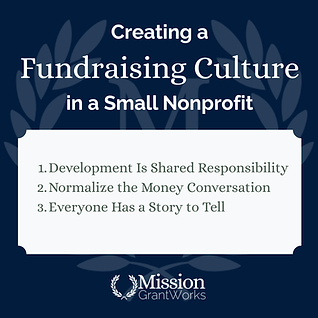
A healthy fundraising culture exists when fundraising is understood as a shared organizational responsibility, not an occasional campaign or one person’s job. Board members, staff, and leaders understand how revenue supports the mission and the role each person plays in sustaining it.
For leaders of small and growing nonprofits, fundraising can feel constant, uncomfortable, and unclear.
So, we do what we know to do. A quick email. A push before payroll. A campaign when cash gets tight. It keeps things moving, but it’s hard to build sustainability that way.
Organizations that last make a deliberate shift. They build a healthy fundraising culture.
A sustainable fundraising culture is reflected in the way your organization thinks about money, mission, and responsibility. So, what exactly does that mean?
What is a fundraising culture?
A healthy fundraising culture is a shared understanding that inviting others in is on everyone's job description.
Everyone knows you need to generate revenue to fund the mission. Staff understands where the dollars come from. Board members understand their role in sustaining them. No one assumes fundraising belongs entirely to someone else.
In a healthy organization, money is not an awkward or avoided topic. It is talked about openly, respectfully, and consistently.
When fundraising becomes part of the culture, it shows up both in everyday conversations and in the way you plan for the year.
If that is the goal, where do you begin?
You begin by changing how you think about fundraising in the first place.
How do we build a fundraising culture?
If you think of fundraising as an event, it feels clunky and transactional. You send a letter. Host a dinner. Run a campaign.
When leaders embrace fundraising as part of the mission, everything changes.
You craft that partner letter with care. You host a dinner to connect. You invite heart-aligned givers into the work.
Why? Because you are not asking for money. You are giving people an opportunity to participate in something they believe in.
That heart-shift changes the tone of everything.
Even on a small team, everyone can communicate the mission. Everyone should understand that funding fuels impact. Everyone tells their impact stories. If your board and staff struggle to describe the organization consistently, a Case for Support can give everyone shared language to work from.
Fundraising is not separate from program work; it is how the work continues. If fundraising is part of the mission, how is the mission funded?
Why does balanced funding strategy matter?
In a strong fundraising culture, no single funding stream carries the whole organization.
Grants are not the plan. Events are not the plan. One major donor is not the plan.
Healthy nonprofits build balanced portfolios.
Individual giving provides stability and relationship depth.
Grants can accelerate defined initiatives.
Earned revenue, where appropriate, can diversify income.
When leaders understand this mix, decision-making becomes steadier. You are less reactive. You are building something that can last.
And if you’re building something that lasts, who is staying with you for the long haul?
Why is donor retention important for small nonprofits?
New donors are a healthy sign of forward movement.
Sustainable growth comes from nurturing and retaining those relationships.
If someone gives once and never hears from you again, something is missing.
A strong fundraising culture pays attention to the people who are already invested.
Are they thanked promptly?
Do they hear what their gift made possible?
Are they invited to stay connected?
Retention reduces the pressure to constantly replace people who drift away. It builds predictability into your revenue and depth into your relationships.
For example, a donor who gives $250 three years in a row is not small. That is a $750 relationship. And more importantly, it is someone who trusts you enough to stay. People stay when they understand the impact of their giving.
And people understand impact through story.
How does storytelling strengthen fundraising?
People do not connect to metrics. They connect to people.
Your program staff sees change up close: a client returning with better news, a student gaining confidence, a family stabilizing.
Those moments are not side notes. They are evidence of impact.
Often, the people closest to the work hear these stories. The people funding the work do not.
A fundraising culture captures them on purpose.
In newsletters.
In board updates.
In grant narratives.
In donor conversations.
When storytelling becomes habitual, you are not inventing language to ask for support. You’re simply sharing what is already happening because you showed up.
If story is part of the culture, so is responsibility.
Who is responsible for fundraising?
In small nonprofits, one person often carries the development title.
Yet one person cannot carry that work alone.
Board members express gratitude and open doors. Program staff understand outcomes and share what they see. Executive leaders speak plainly about financial needs and long-term goals.
No one is writing every appeal or managing every donor relationship. Everyone understands how their role connects to revenue.
When development is isolated, it eventually becomes exhausting.
When responsibility is shared, it becomes normal.
This shift has less to do with staff size and more to do with clarity. People need to understand who does what and why it matters.
So, what does a healthy fundraising culture look like in practice?
A fundraising culture is built through habits.
Board: Plans deliberately for a balanced funding portfolio and knows where gaps exist.
Executive Director: Models the understanding that inviting others in is part of the mission; leads donor conversations with clarity and authenticity.
Program Staff: Share stories and measurable outcomes regularly, so donor engagement stays anchored in real impact.
Donors: Receive consistent communication and genuine gratitude, not just outreach when a gift is needed.
Volunteers and Champions: Bring new people into the mission and take an active role in widening the circle of support.
Shifting culture is not quick work. Over time, these habits create stability.
Appeals are strategic, and relationships are nurtured year-round. Leaders make decisions with a clear view of both mission and margin.
If fundraising currently feels reactive or overly dependent on one person, that is useful information. It tells you where your structure is thin.
🌟 If fundraising feels reactive or overly dependent on one person, that may be a sign that something in your organization needs strengthening. The free 10-question grant readiness Self-Audit Tool can help you spot strengths, gaps, and next steps.


